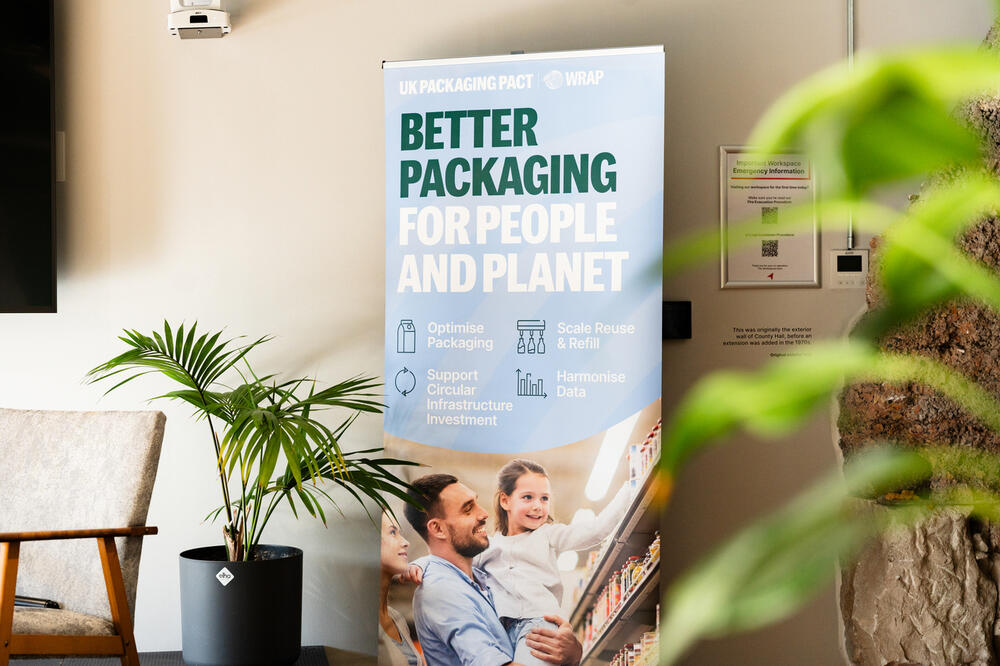
WRAP has officially launched this British Packaging Pacta ground-breaking ten-year collaborative program aimed at fundamentally transforming the UK packaging system.
As a successor to the world's first UK Plastics Pact, this new voluntary agreement expands its scope beyond plastics to include all packaging materials brought to market – glass, paper, cardboard, metal and bio-based materials.
With nearly 100 founding signatories, including major retailers such as Aldi, Sainsbury's, Tesco and Lidland FMCG giants like Unilever, Danone and Müllerthe pact reaches a critical point for the food and beverage trade. It is intended to act as a “unified systems approach” to help companies navigate a rapidly changing regulatory landscape, including the Extended Producer Responsibility (EPR) and the Deposit Return Scheme (DRS).
Four strategic goals for a circular economy
The pact is based on four interrelated pillars that will guide the industry's actions until 2035:
- Optimize packaging: The focus is on eliminating single-use and problematic materials, “right-weighting” designs and increasing recycled content – particularly plastic and glass.
- Reusing and refilling the scale: Promote standardized, interoperable systems to move the market away from single-use models.
- Support infrastructure investments: Building a reliable evidence base to unlock funds for the UK's recycling and remanufacturing infrastructure and address current bottlenecks such as non-recyclable multi-material films.
- Harmonize data: Simplifying reporting requirements by aligning UK and EU standards to reduce the data burden on businesses.
Navigating regulatory storms
The launch comes after stark warnings from WRAP and the World Bank about increasing global waste. Catherine David, CEO of WRAP, emphasized that while policies are essential, they alone cannot bring about change.
“The Packaging Pact will bring about the necessary practical changes through a flexible framework,” explained David. “Today we begin to make progress – to reduce the cost of doing business, mitigate risk and prepare for the future.”
For food and beverage manufacturers, the pact provides an exclusive mechanism to influence and shape upcoming government reforms. By participating in the pre-competitive collaboration, signatories can:
- Reduce EPR Fees: through smarter design and material reduction, which reduces the tax burden
- Future-proof operation: Adapting to evolving UK and EU regulations before they become mandatory.
- Reduce emissions: Packaging is responsible for around 3% of total emissions from the food sector; The pact provides a roadmap to drive this towards net zero.
The roadmap until 2035
The first year of the Pact will focus on identifying opportunities to reduce materials and providing policy advice to incentivize investment in critical recycling infrastructure. This activity will lead to the publication of a final packaging roadmap in early 2027.
The ultimate vision, according to WRAP, is to fill that “Supermarket of the Year 2035” with products in minimal, efficient packaging designed for reuse, ensuring every item purchased is recycled and never wasted.
“Much of the UK recycling markets have failed over the last decade due to poorly designed composite packaging. “The UK Packaging Pact offers a clear opportunity to identify real investment opportunities in better packaging and more recycling infrastructure in the UK.” Dan Cooke, Director of Policy at CIWM.
The official launch represents a major step forward for the Food & Drink Federation (FDF) and the British Retail Consortium (BRC), both of which are founding supporters of the initiative.
About the Author